
- cross-posted to:
- science_memes@mander.xyz
- cross-posted to:
- science_memes@mander.xyz
You must log in or # to comment.
deleted by creator
To expand on the “doesn’t work like that” part: In the vacuum of space there is no air to exchange warmth with your body, or your space suit. You might be comfy on the side of your body facing the sun (if you’re at that distance where it provides the right amount of radiative heat) but the side facing away from the sun will get no heat, and therefore be cold. I imagine that would feel very weird… if you could feel it on your skin, without a space suit, without being ripped apart by the vacuum, of course.
Does anyone know whether this “uneven distribution of heat energy” is a problem for space suits or if that little bit of air inside is enough to distribute it?
NASA EVA suits have liquid (water) cooling systems to avoid cooking the astronaut while outside the ISS.
I don’t know how they actually work though. The only way to shed the heat is to radiate it away or to sink it into warming something else up.
Found this on Wikipedia:
In an independent space suit, the heat is ultimately transferred to a thin sheet of ice (formed by a separate feed water source). Due to the extremely low pressure in space, the heated ice sublimates directly to water vapor, which is then vented away from the suit.
The ice sublimator consists of sintered nickel plates with microscopic pores which are sized to permit the water to freeze in the plate without damaging it. When heat needs to be removed, the ice in the pores melts and the water passes through them to form a thin sheet which sublimates. When there is no need for heat to be removed, this water refreezes, sealing the plate. The rate of sublimation of the ice is directly proportional to the amount of heat needing to be removed, so the system is self-regulating and needs no moving parts. During EVA on the Moon, this system had an outlet gas temperature of 44 °F (7 °C),[1] As an example, during the Apollo 12 commander’s first EVA (of 3 hrs, 44 minutes), 4.75 lb (2.15 kg) of feedwater were sublimated, and this dissipated 894.4 BTU/h (262.1 W).[2] The pores eventually get clogged through contamination and the plates need to be replaced.[3]
Though I think that’s specifically for removing the astronaut’s body heat.
What a great system. I wonder how the development of that worked. Did they theorize the necessity of a system like that or were the first space walkers quite unconfortable?
It’s also for removing the suit systems heat, and heat from sunlight. As much as we love to say space is cold, the problem things in space have is the exact opposite. Without air for the convection or conduction of heat things in space, be they satellites, a space station, or a human in an EVA suit, have a very hard time expelling heat. The International Space Station has enormous radiators on the dark side of it’s solar panels for this very reason, getting rid of heat is hard when you can’t just blow air over a heat sink.
Also, for what it’s worth, the average energy of what few particles there are in the vacuum of space tends to be pretty high, but they’re so dispersed that it’s entirely negligible.
I always try to explain that space is cold on average but near a star it is really hot.
Case in point: the Earth. Standing on its surface under 100km of atmosphere, the sun will still burn your skin in minutes… imagine sunburn without the ozone layer.
There are glacier fed lakes when i live. You can float in incredibly cold water and if you have just the right equilibrium you can half float in freezing cold water while half getting a nice sun bath. And it IS very weird.
One spot I camped at for many years had nice sandy area that was about 200 meters out into the lake before a drop off. As it was only about a meter deep it used to warm up the top foot or so of the water when it was fairly still and you could stick your arm down into the water and actually feel the temperature drop like there was a line underneath the water.
Was great place to camp before it got overwhelmed by mosquitos
A lot of nice places in the world that are a joy to be in until the mosquitoes show up. Do we have to have mosquitoes? Can’t the world manage without them?
We’re gonna find out one way or another. They already released genetically modified mosquito into the normal mosquito population several years ago. If everything goes to plan, those specific species of mosquitoes that also happen to bite humans, should completely die out in the next 100-200 generations.
I have no idea how short a mosquito generation is, but I suspect that means 50-200 years.
Entomologists will always be happy to write about it.
Let’s say about a 50 day lifespan, that’s roughly seven generations in a year, so maybe about 14 years? If the bitey mosquitoes aren’t gone, at least the worst of the world leaders should hopefully be dead by then.
Oh wow, that sounds amazing! Apart from the mosquitos maybe.
If I can find some old pictures I’ll share
What if we spin around like a spit roast so the heat gets evenly distributed?
How fast should we spin as well?
I wonder what it would do in relation to vertigo. I mean there’s no gravity to affect the vestibular system, but there are strong visual cues.
Ah crap, I’m going to go down a “what happens when an astronaut spins” rabbit hole today, ain’t I? I had shit to do, oh well
Why can some objects exist in space without getting ripped apart like a human would. Is that what actually happens to a human anyways?
Ever seen a picture of a blobfish in it’s deep ocean habitat vs when it is at the surface? It’s body is adapted to the extreme pressure of the deep sea, and when that pressure is no longer there, the forces keeping it’s shape are no longer present and thus every bit of it expands. That’s what would happen to us in the vacuum of space albeit on a lesser scale. Also, we’re like 70% water which boils in a vacuum.
As I understand it, this in fact will not happen. Our circulatory system is a closed loop and strong enough to not expand into vacuum. The water inside our body is kept close to usual pressure by our skin, blood vessels etc.
The main immediate danger in space without a spacesuit would be holding your breath. Your lungs are not built to withstand a whole atmosphere of pressure from the inside, and will get damaged if you hold your breath.
Of course if you don’t, you’ll have another problem.
Thanks for the clarification. I knew the whole lungs problem and that was really what I had in mind but just kind of assumed there’d be similar dangers to other bodily functions but I see that’s not the case.
I do believe the water would still be an issue for your eyes and maybe even mouth but good to know you wouldn’t immediately have blood literally boiling in your veins.
I agree that the water exposed to vacuum would evaporate over time, but I’m not sure it would be directly harmful beyond the dehydration.
This uneven heat distribution confuses the brain and is perceived as pain. Veritasium (or maybe vsauce) did a video on it. Putting frozen and warm hotdog against the skin.
But imagine the side facing the sun is comfortable. Then it keeps warming up. And it keeps warming up. And you try to cool down, but it doesn’t cool, it just stays the same temperature or keeps warming up.
the uneven heating would likely feel like being next to a fireplace
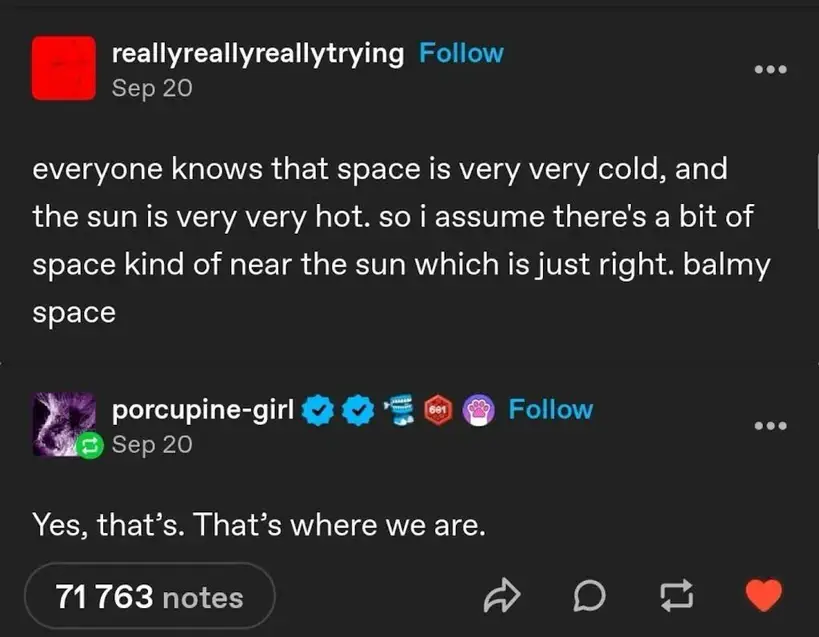
You don’t think a function of the temperature from the sun to the earth forms a continuous line? You think it’s piecewise? It’s continuous! Yeah it probably bottoms out to effectively zero pretty quick, but there’s some distance from the sun that would be the right temperature. Sure, the other rays from the sun might not make it livable. Sure, it might be so narrow there’s no way to effectively keep yourself in orbit there without getting sucked closer and burning up. Sure, it’s a dumb thought experiment, but there’s no way there isn’t some point where it’s comfortable.
The thing about temperature is that it’s not instant. Radiation from the sun heats stuff up, and that heat is absorbed by whatever the radiation hits according to its reflectivity and shape, and then lost from conduction, convection, and radiation. The characteristics of what’s being heated by the sun and the environment it’s in are what determine how hot it gets.
Exactly, so there must be some environment between us and the sun that’s comfortable.
deleted by creator
The atmosphere does just “stop” either though. It also forms a gradient. There’s not a magic barrier where the atmosphere is and isn’t. It just gets gradually thinner and thinner. So in the same way there’s a Goldilocks spot in the atmosphere where it’s a comfortable temperature without being too cold, there must be another one near the sun.
Besides, heat radiation travels through a vacuum. If it didn’t then the Earth wouldn’t get heat from the sun at all.
It travels through the vacuum, but it doesn’t heat the vacuum, there’s nothing there to heat. The “Goldilocks spot in the atmosphere” is on the ground, that’s why we live here.
When you’re close enough to the sun it heats you enough, because at some point you’re so close you’ll burn up, and at some point you’ll freeze, so there must be a point between them that’s comfortable. (And yes that might involve spinning so you don’t cook on one side and freeze on the other.) Never said it “heats the vacuum”.
Never said it “heats the vacuum”.
But the theory that the space (proper outerspace space) in-between Earth and the sun has an even temperature gradient assumes that it does.
I literally never said it’s even, only that if you plot it out it would be continuous instead of piecewise.
deleted by creator
I’m not a scientist, but I’m pretty sure temperature is the energy given to the molecules in the air by the radiation from the sun. Since there is no air in space to excite, it’s just really cold until it’s not.
The photons would directly excite the molecules in your body.
Which is why space suits are white. If they were darker, you‘d get cooked on a space walk. In a vacuum, the sunlight can heat you up but it’s much harder to radiate heat away.
Physics sure is exciting!
so hot right now
deleted by creator
Yeah, temperature in space just doesn’t match up with our human common sense experience at all.
There’s convective and radiative heat, while the first one needs some medium to transmit energy (air…), the second one simply beams it onto you
3 mechanisms for heat transfer: conduction (heat moves from one bit of matter to another when they are touching), convection (in a fluid, hot matter move about), and radiation (pure heat, only form that goes through a vacuum, this is just like lower frequency light that we can’t see).
Thanks, I thought conduction was under convection, so to say
Okay, thank you. I’m not a very smart man, and had always wondered how planets can be heated by the sun but not space itself. It never occurred to me it’s because of the vacuum of space that keeps it cold.
Gotta have stuff to be heated. Nothing can’t be heated. But the energy that heats stuff can still pass through the space where the nothing is.
Temperature is how much movement there is at the molecular or atomic level(depending on how you are measuring.
There is a lower limit, but no upper limit on how much heat can be measured.
This is the basis of the Kelvin scale and starts at absolute zero or the temperature at which all movement (energy) stops
Air is a medium. Flowing air is a decent heat exchanger, still air is bad at it
Lemmy.world amirite?!! Well akshually…
deleted by creator
Don’t worry about it
I’ve heard that basically everywhere you go in space you will die by overheating because your body can’t radiate away the heat it generates. It’s weird to think that you can die from literally being cooked alive in a vacuum with a temperature of 0 degrees (readers choice of units).
Temperature is one of the least intuitive things when really getting into the nitty gritty of it. One of my favorite things to prompt people with is to ask them what makes something twice as hot as something else?
Temperature is the average speed of atoms, in space, what atoms?
Space isn’t cold. It just isn’t any temperature
Right, so getting to that whole “temperature is a measure of average speed of atoms,” what’s the average speed of atoms in 100 degrees Celsius boiling water vs 100 degree celsius steam? Or for that matter any solid at any given temperature compared to any gas of the same temperature? See what I mean when I said not intuitive?
Also, even in a vacuum a thermometer will eventually settle on a temperature it’ll just take longer to equalise.
Atoms move in a solid, they just vibrate, in a liquid and glass they fly around. Somewhat bonded to each other in a liquid. But the speed is the same for any given temperature.
In vacuum I think a thermometer will just go to absolute zero/boil off.
That is just not true mate. A better working definition for temperature is the average kinetic energy of molecules not average speed of them. Smaller molecules such as hydrogen will move much faster than larger ones such as water at any given temperature. KE = 1/2mv^2
And no a thermometer in a vacuum will settle to the ambient temperature of it’s environment. Nothing will settle to absolute zero. Either an object is in a true vacuum (theoretical doesn’t actually exist) in which case it will remain its current temperature forever or for objects in the vacuum of space it will equalise with the temperature of it’s surrounding environment.
Rather than reader’s choice of units, it has to be Kelvin… 0F or 0C is warm in absolute terms.
AcKsHuLlY it could also be in rankine
I’m being pedantic as fuuuuuck because I’ve never actually seen it used in real life. For those that don’t know, it’s similar to Kelvin in that 0 is actually absolute zero, but the degree step sizes are the same as fahrenheit
Rankine is used in chemical engineering calcs because a lot of US chemical plants are built in US Customary units and it’s a lot easier to calculate in Rankine and keep everything in that system than try to convert back and forth between K and F.
Thanks for the interesting info! I figured it was used somewhere, just hadn’t seen it.
And reminded me of the unit I saw once that I hate the most. Kilofeet… Not kidding. Apparently used in telecommunications as a unit of length for spools of cable, probably for similar reasons of easier math but couldn’t fully switch from the US standard.
Lmao that too. We use kilopounds as well because tons are too easily confused with metric tons
Also, Kelvin doesn’t have degrees.
Sure but all three are colder than body temp
It’s exactly like being trapped in a thermos. But! There are space suit concepts that use an airtight helmet, but the rest of the body effectively is exposed to vacuum, supported and protected using a skin tight water-permeable fabric that prevents you from swelling up or burning in the UV. One of the benefits of this kind of space suit is that SWEATING WORKS IN SPACE!!! The sweat carries away heat (and further consumes it in the phase transition) when it instantly flashes to vapor, cooling one’s body. Sweating is a human super power and we can leverage it to perform our own temperature regulation in a vacuum! I’ve always thought that was super cool.
That is super cool!
Physics is wild, man.
and then there is the wet light bulb situation where your body can just suffocate as it sweats and cant evaporate.
We’re basically just porous critters. Just assume we need to breath from everywhere on the body.
Instead of wasting our resources trying to terraform Mars, we should look for planets already in this “balmy zone” to live on.
You mean like not fucking up the planet we live on? That’s impossible, you’re insane.
¡terraform earth!
yeah, if we could terraform mars, we could terraform earth too. i’m in the “let’s put all the pollution on the moon” camp
We are terraforming, just in the opposite direction.
We’ve had one planet, yes. But what about second planet?
“I don’t think he knows about second planet, Pippin.”
Here’s an idea, let’s clean up our home.
Reaching mars is far more achievable than reaching another solar system.
Thankfully there’s a planet already in the balmy zone in this solar system, and even better, it already has an atmosphere we can breathe!
Space has no temperature. Space is a vacuum. Temperature needs things to jiggle.
The average temperature of the universe today is approximately 2.73 K (−270.42 °C; −454.76 °F), based on measurements of cosmic microwave background radiation.
https://en.wikipedia.org/wiki/Absolute_zero
Cited from https://www.abc.net.au/science/articles/2003/09/25/947116.htm
Wonder how they calculated the “average” temperature. Was it weighted by mass or by volume?
Only mass-weighting really makes sense here imo
Wouldn’t that be just star and not star?
No - it’d mostly be dark matter vs not dark matter.
I’m still on the “dark matter isn’t real” train. It would be so unsatisfying if it was the answer.
Dark mind is definitely real though
Doesn’t matter, it’s just the eventual temperature of a black body kept in deep space
That’s purely academic. IRL what actually matters is “how big and reflective is the thing you’re in”.
You’d get real hot real fast in a matte black space suit.
Well yes, because space is not actually a complete vacuum.
But a thing in space is not a vacuum and is subject to heating via solar radiation
And actually, space only gets cold (more surface radiation cooling than solar heating) a bit after Mars orbit. On earth orbit, it’s already a bit toasty.
Yeah, that’s kinda why it’s cold. Cold is just an absense of heat.
Cold is the absence of heat in a medium that can interact with temperature imo. It certainly wouldn’t act like normal cold; if you stuck your hand out and felt the vaccuum, it wouldn’t feel cold, and the heat in your hand would not flow outwards into space very much. There’s no convection, only radiation. Space isn’t cold, matter is cold, and there’s no matter.
The half of you not facing the sun would freeze, even on mercury it gets cold at night
I will simply sit on an office chair and spin around like doner on a rotisserie
You can do that without a chair in space.
Now I want a doner
Now I want a chair
Spinning is conveniently like the one way you can move in space by yourself
If you’ve got even modest infrared insulation, though, your metabolism is more than enough to keep you from freezing. No convective or conductive heat transfer makes getting rid of heat more of a problem.
Spin on it like a rotisserie chicken!
wear a coat
Literally. It’s adorable seeing kids figure things out like that, though :)
I don’t think they’re trying enough.