- cross-posted to:
- climate@slrpnk.net
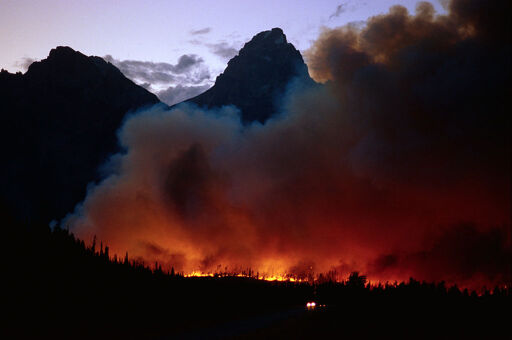
Once an ice sheet begins melting or the Amazon rainforest begins dying, the process will not simply stop when emissions fall. We cannot hold blind faith that future emissions reductions or reversals can or will reverse avalanche-like changes to the natural world — and these pages are a convincing scolding of the policymakers for whom “conservatism or fatalism about society flips into extreme adventurism about nature.”
…
…despite Trumpian and Republican bluster, “a regime that embraces climate breakdown as the flipside of fossil fuels is preparing to treat it with something like sulfate planes,” especially if doing so would help reduce climate-caused migration from south to north.
In other words, a future energy secretary may well disagree with Wright that global heating is “no big deal” but agree that American oil must keep flowing and burning, and share the current administration’s xenophobia and penchant for mass deportations and illegal arrests in service of white nationalism. Such a global hegemon could dim the sun to square the circle.
Why so little analysis of the Communist Party of China from an author (Malm) who has called in these pages for an “ecological Leninism” and praised how Geoff Mann and Joel Wainwright explore the idea of an authoritarian, state-centered response to the crisis — a “Climate Mao” — in their 2019 book, Climate Leviathan?
now why would the author leave out the only ones called communists
groan
So legitimately curious here, has claimant crisis predictions been that widely incorrect in terms of time or what? It seems, to me, predicted deadlines have come and gone with no repercussions to the human race. I know it’s not just about the human race but unfortunately that’s going to be the only way to make the point hit home.
Uh, so far scientific predictions about the climate from even 20 years ago have been quite accurate, or a bit too optimistic. The scary predictions are for 50 to 200 years in the future and later. It’s just a very slow process (in human terms). Put CO2 into the atmosphere for a decade, not much happens. Put more CO2 in for another decade, it gets slightly warmer. Stop putting CO2 into the atmosphere, and the CO2 stays there for many hundred years, and the effects keep getting worse.
By the time you notice the bad stuff happening around you (desertification of farmland, floods, sea-level rise in coastal settlements), it’s too late to realize that you don’t have a technology to put the CO2 out again, and even if you did it would take another decade until you notice the effect.
There was never a climate doomsday clock, at least not from any legitimate scientific sources. Scientists don’t make predictions, they’re not soothsayers or fortune tellers. It is, however, useful to try and project into the future. They do this using models. Unfortunately, even the most accurate climate model can’t have anywhere near a high enough fidelity to tell each person on the planet exactly how they will be personally impacted by climate change. But that’s exactly what makes climate change so concerning. There are a lot of unknowns, and it just generally makes the future more unpredictable than it otherwise would have been.
The Earth’s climate has been relatively stable for essentially all of our existence as a species. That’s going to change. It already has. We’re in that process now. That is irrefutable. And these changes will happen at a nearly unprecedented rate. Even relatively rapid temperature changes in Earth’s history usually unfold over tens of thousands of years. What we’re observing is unfolding over decades. That in and of itself is concerning, even if we don’t necessarily know exactly how that is going to impact each person individually.
Honestly, the best thing is just not to find out. Why risk it? Does it really make you feel any better knowing that we don’t know exactly what’s going to happen as a result of this unprecedented process? We should cut global greenhouse gas emissions to net zero as quickly as possible so we don’t have to worry about what might have happened if we didn’t.
Reactions to fake news alarmists of the past now inform people’s reactions to legitimate climate science communication.
One example: West Antarctic glaciers are largely laying on bedrock way below sea level. Sea temperature rise of a certain amount of time (decades) triggers a complex mechanism where those glaciers’ floating edges no longer support the the thick ice laying on bedrock under the sea level - a slow-ish, but irreversible process of melting of the whole ice sheet begins. Thus, the longer the glaciers are exposed to high sea temperatures the more likely the irreversible outcome. In my understanding, this also informs activism: Make noise early, when there are still major points to win, but once you lose hope of change, your cause seems lost to you. With the WAIS melting, last I checked (5 years ago) this can take up to 13kya or several hundred years, depending on human temperature forcing on sea temperature, ie how much we try.
Another point: A climate win would be really anticlimactic, because it is only truly knowable beyond our lifetimes and it looks like no change.