
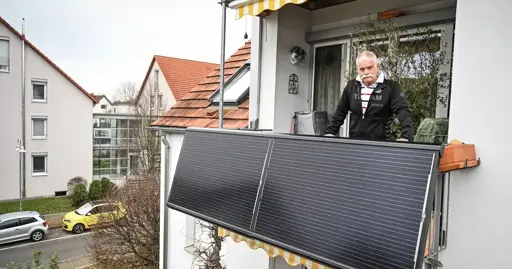
Bunch of reasons. Power is pretty cheap, thats the big one, so the payoff is long long away… The infrastructure you need even for a small solar array to prevent feeding back into the grid when you aren’t supposed to isn’t really developed here for small-scale deployments. We have big hailstorms, someone has to pay the insurance bill. Just a bunch of reasons.
Solar and wind in spite of the rhetoric is really big here, so not a lot to gain by expensive small solar installs.
None of what your said is true.
Cheap power vs expensive individual cells, the financial incentive is not there- this is Central Texas, your mileage may vary:
As of 8:30 AM, solar is nearly 30 percent of statewide generation, with wind at 16 percent (see fuel mix):
404 error. But funny you’d bring up Texas, with some of the most expensive electric bills in the country.
There are inexpensive setups, that are literally plug and play, and they shut off within milliseconds of grid going down.
In WV, we have cheap electricity. Problem is the fees double the entire bill. I did the math, and the expense would’ve paid itself off within 2 years.
https://austinenergy.com/en/rates/approved-rates-schedules
I never heard Texas had the highest rates. You can have high rates if you sign up for them, but Austin Energy is pretty low. I also did the solar payoff calc and it was like 25 years at my current usage and rates.
Probably because anything but petroleum is communism.
Because our owners haven’t allowed us.
That is pretty true when looking at tarrifs against china
It’s good to know there are people in the USA aware of how things are in their country.
Because the US is full of absolute backwards redneck suckers who are convinced that oil is still the future.
Lobbying is far too powerful, and ethics nowhere in sight.
solar panels are dei
Because of electricity costs in Germany it is a real no-Brainer but US has much cheaper electricity and I am not sure whether US plugs or electrical systems are up to the task tbh.
That will change when the panel paid for itself. When your electricity costs double, solar has a quicker ROI. But it will pay for itself really quickly, even in areas with cheap electricity
Let’s do the maths quickly;
a full set of 2kW generator power and a 5kWh battery is sold in germanyfor around 1700€ right now. Let’s assume 2000€ since we might need something to install them and maybe a power meter to only feed in as much as we need right now.
From my experience over the last two summers, such a system might generate some excess during the summer that might be lost in a personal sense. To compensate for that excess and conversion losses when (dis-) charging the battery, we’ll assume 20% less generation than I’ve experienced over a 12 months period.
We pay 1000€/1kWp generation capacity. Each kWp generation capacity shall yield 800 kWh electricity each year, so our system will yield 1.600 kWh/a.
So if we currently pay 0,30 €/kWh, we will save 1600 kWh/a * 0,30 €/kWh = 480€/a. Which means our 2000€ investment will have itself paid off in 2000€ / (480€/a) = 4,17a or 4 years and 2 months.
If we assume an expected lifetime of 10 years, we get a generation cost of 2000€ / ((1600kWh/a) * 10a) = 0,125€/kWh
You might wanna keep in mind, that some of these systems provide some limited backup functionality to keep your fridge or other important devices powered during a blackout without any additional costs or maintenance as you might need for a generator backup.
That is not your bog-standard balcony solar installation and a 5kWh battery is way too much. You can get a 800W installation for 250-350€:


Let’s say 300€. At 0,30€/kWh you reach your ROI at 1000kWh produced. Production depents on your locality, but it should be between 800-1100kWh for a 800W installation. So it takes approx. 1 year to get your investment back. The rest is pure profit. Yes, that might take a bit longer in practice. You are not using the full 800W at noon on workdays while you’re away at work. You might not have perfekt alignment with the sun. And so on, but it is really quick.
If you are paying 0,15€/kWh, you might need 2 years to reach that ROI. That still is an awesome investment. Take a small sum of money. Invest one or two hours of work installing it. And if you are calculating with German prices and 10 years lifetime, you get 1000kWh a year @ 0,30€/kWh for 10 years = 3000€.
I ran fine with 2kWh storage and 1.6kWp, so yeah anything bigger than that might idle and therefore just delay breaking even.
not using the full 800W at noon on workdays
That’s why I would still recommend any battery. Not just to save some energy into the evening where electricity prices regularly spike in germany, but also to store in short-term when running a laundry machine on a so-so day.
Nonetheless, those small solar plants are likely always viable and I do regularly recommend them even if not asked :)
Because there is no climate change in the US!
Because apartment living is far more common in Europe, and tenants generally have more rights as to what they can do with these apartments compared to the US. I can’t imagine trying to get an apartment building in the US to allow you to wire in a solar battery and hang panels off the balcony, they’d never agree. A quick read shows that balcony solar became a right of sorts in Germany in 2024. Americans have no such allowance.
None of us can afford a balcony!
For everybody, who doesn’t know: You do not need a balcony. You just need some space to place the panel where the sun is shining. I see them also on roofs, on carports and garages, even on the lawn.
Nor solar panels, nor a place to live.
Balcony solar bill dies in Illinois after union voices… | Canary Media
Balcony solar bill dies in Illinois after union voices opposition
Legislation to open the door for small plug-in solar panels hit roadblocks, including safety concerns raised by the state’s electrical workers union
https://www.canarymedia.com/articles/solar/balcony-solar-bill-dies-illinois
… Was there no expert on the topic to tell them how it al worked or…?
They’re worried about power feeding back into a “dead” grid while they’re trying to work on it.
Typical solar installations either shut down when the power goes out or you have a battery/expensive switch that automatically disconnects you from the grid when the external power goes down.
The switch is expensive enough that it’s usually not done without a battery.
Exactly my point. An expert would tell them thats not how it works at all. Never would it feed back to a dead grid. The rest of the world figured that one out ages ago…
The answer is draconian regulations and apartment owners that aren’t concerned with decreasing their teammates power bill. Half the country is still debating if climate change is real.
Do these panels just plug directly into a GFCI outlet? Or do they use battery storage?
There are some legitimate safety concerns for plug-in solar/battery systems, mostly related to firefighting.
With public utilities, the electrical service to a building can be cut off externally. If there’s a fire, a live damaged electrical cable can reignite fires after they’re put out, especially after the building is flooded with firefighting water. This also presents a potential shock hazard to firefighters. If the building has plug-in solar attached, there’s no way to know which circuits might be energized or which walls might have live power in them (punching through interior walls is pretty common during fire rescue), and also no way to shut the power off from outside the building. If the system also includes a lithium battery that creates an additional problem.
Lockout/tagout for electrical maintenance also becomes more complicated, because the main breaker no longer controls all of the power for the building. Plugging in a system like this to a power outlet completely bypasses the building’s breaker panel, and therefore bypasses all of the safety standards that rely on that breaker panel. It’s not impossible to address, but some thought needs to be put into it and I can understand why some jurisdictions might just say “nope, we’re not dealing with that.”
I’m not sure how Germany is addressing these issues. I don’t think it’s enough to justify prohibiting the use of these systems entirely, but there is justification for establishing some safe and sane regulations around them, and not just rubber-stamping them broadly.
I’m not sure how Germany is addressing these issues.
Simple.
-
When there is no power in the grid, these devices shut down automatically.
-
The balcony panels have an output power limit of 800 Watt, to prevent overloading of house-internal wires. If there is more power, it can be stored in a battery.
-
There are some legitimate safety concerns for plug-in solar/battery systems, mostly related to firefighting. With public utilities, the electrical service to a building can be cut off externally. If there’s a fire, a live damaged electrical cable can reignite fires after they’re put out, especially after the building is flooded with firefighting water. This also presents a potential shock hazard to firefighters.
That’s missinformation. Those systems are built so that they switch off when the grid goes down. Those problems you are talking about is mostly happening when people are starting to power their homes with diesel generators during a blackout.
All of this is misinformation and a non-issue. As said before the systems disconnect from the grid if the grid has no power. This is a technical system that needs to exist since the output power needs to be in-phase with the grid. No frequency to go by = no power.
Batteries are a different thing, and they work differently, but solar panels have no such thing.Edit: just read up. When the grid disconnects the battery disconnects everything from grid and generates its own voltage and frequency for the system in your house (including solar panels)