

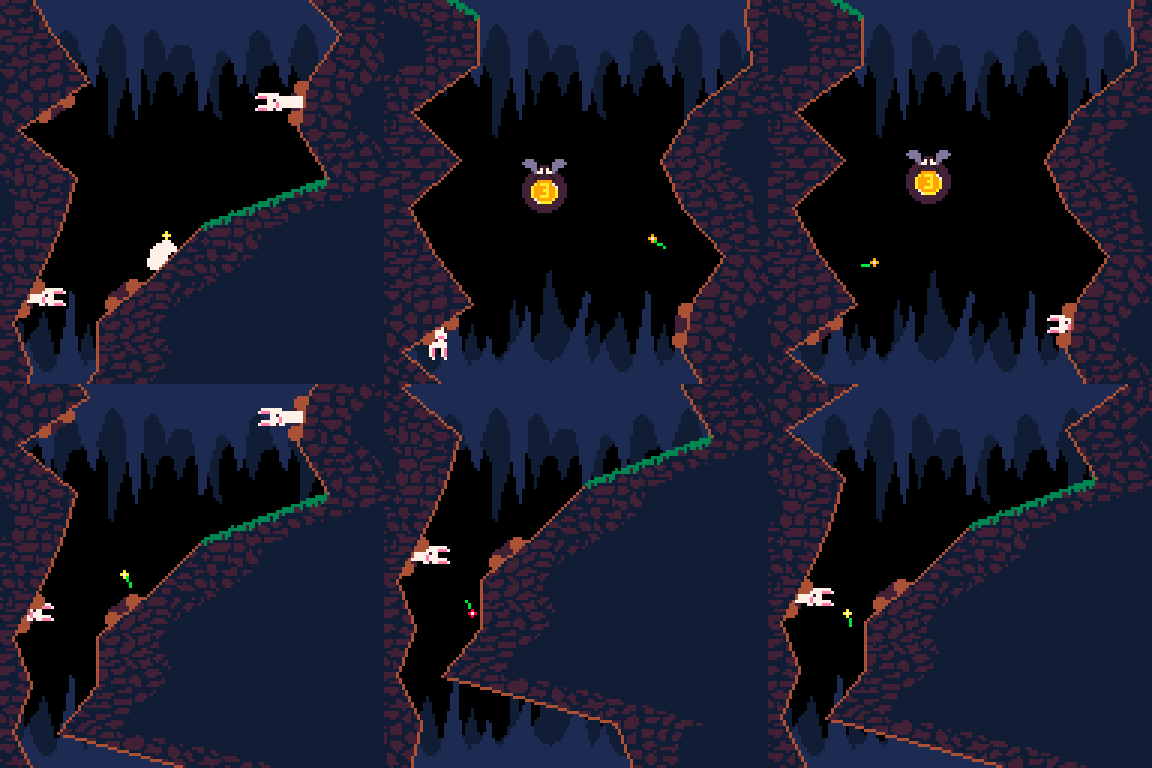
In Love Me Not you are a flower that climbs out of a cave. The cave has been cursed by a witch, so the level is regenerated above you whenever you fall.
This is similar to the procedurally generated levels in infinite runners like Doodle Jump, except that instead of erasing the entire level on a failure, Love Me Not only erases the most recent sections. This style of level generation is novel to me. For the purposes of this post I’ll call it spool generation.
I often simplify a player’s time with a game into a “novice period” and an “expert period”. These are usually characterised by different goals. In Love Me Not a novice’s objective is to escape the cave by any means necessary, while an expert’s objective is to escape the cave as fast as possible.
Spool generation had some natural effects on the novice period:
[expert period] I wanted to find a scoring system that could bring spool generation back into the decision space of an expert player.
Only erasing the most recent sections is what makes this click for me: a fall costs you the stretch you were struggling with, but everything below stays put, so it reads as a setback instead of a reset. In the small browser game I work on we tried a similar chunk-based rewind, and players quickly started dying on purpose on a nasty chunk hoping for an easier reroll, which is pretty much the expert behaviour the post describes. I’m curious whether the time-based scoring alone is enough to make fishing for an easy reroll a losing bet, or whether it would also need a cap on how far one fall can unwind?
a deathless…roguelike?
Every day the term “roguelike” strays further from the light (rogue)
For the item farming problem you could seed the item roll by section index instead of by generation count. Falling would still reroll the terrain, but section 12 always hands out the same thing, so dropping down ten times just gets you the same pickup ten times and the first one is the only one that counts
I wonder if they generate items/XP as part of the level generation, and if the spool generation means that those get regenerated as well when you fall. That would make it exploitable by just falling over and over (and the exploiting isn’t very fun in itself).
Although, I guess, if you set it as the goal to escape as quickly as possible, then that might already naturally give players a reason to not intentionally do it, and also help struggling players out. Probably depends a lot on the details…
In this game at least, there doesn’t seem ot be any items or XP.
But I thought of this as an interesting mechanic as well when they mentioned expert period and deliberately falling to regenerate the following area. It leads to a weighing of lost time due to falling/falling back vs the chance of better alternatives.
Even for a novice period, falling, whether deliberately or accidentally, and getting a better outcome doesn’t seem like a bad thing to me. They describe how that makes progression easier by chance rather than through explicit deliberate game design with easing and fallbacks.
Other games and game mechanics make use of risk vs potential reward too. I’m thinking of roguelites right now where you can pick something up or not or activate something at a cost. A gain may not be guaranteed. Or it offering a reroll of items on offer.
I don’t see this much different. The form is different through level generation/spooling and a different cost, but the tension or strategy mechanism is not fundamentally different in my eyes.
I guess it comes down to what you see as “exploitation”. When you see it as deliberate game design it’s not really exploitation. If it’s deliberately part of the influenced scoring then it’s not an exploit either. Even if it’s multiplayer, it can be part of game depth and game strategy.
Well, in this case by exploitation, I meant basically this quote:
Given the opportunity, players will optimize the fun out of a game.
https://www.designer-notes.com/game-developer-column-17-water-finds-a-crack/
So, if you had randomized items along the way, players might jump down repeatedly to pick up an item many times, and then the rest of the game is not challenging anymore, a.k.a. boring.
Of course, you could do things like only handing out rewards when the player reaches certain heights for the first time.
I just thought about what this spool generation might look like with a more Rogue-like roguelike, and it would certainly be tricky to make it work…
