

cross-posted from: https://piefed.ca/c/britishcolumbia/p/373846/november-2025-ekos-polling-shows-bc-public-strongly-behind-proportional-representation
https://www.fairvote.ca/26/11/2025/bc-committee-recommends-a-citizens-assembly-on-electoral-reform/
November 2025 EKOS polling shows BC public strongly behind proportional representation
Read the full report from EKOS (with analysis).
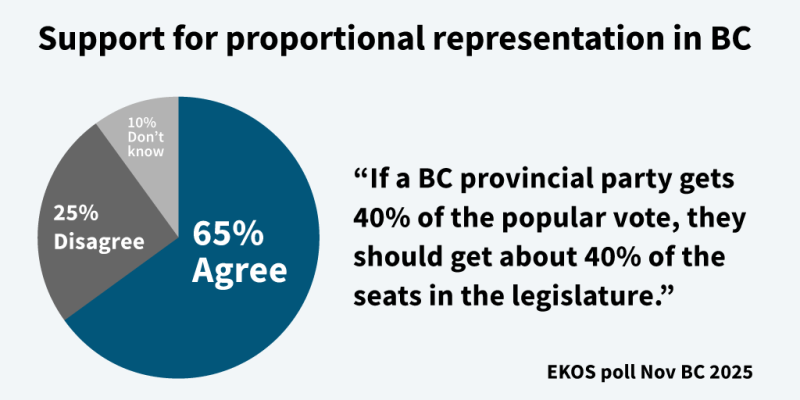
EKOS 2025 poll support for proportional representation in BC pie chart shows 65% agree, 25% disagree, 10% don’t know
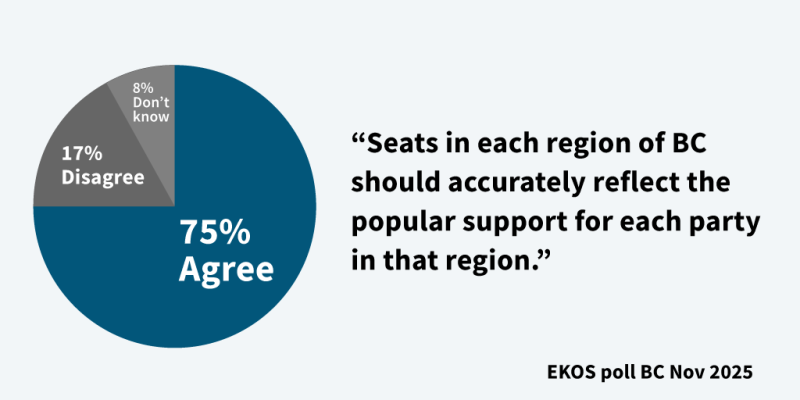
A strong majority of BC voters agree with the fundamental principle of a proportional system – that the seats should reflect the popular vote.
This agreement is even stronger when asked whether seats should be proportional to votes in each region.
NDP voters in the north, Conservative voters in urban areas, and Green voters everywhere should be fairly represented in the legislature.
EKOS 2025 poll, pie chart shows support for seats matching a popular support for parties in each region of BC. Shows 75% agree, 17% disagree, 8% don’t know
Support for proportional representation is high among all voters: 78% of BC NDP voters, 73% of BC Conservative voters, and 82% of BC Green Party voters support PR.
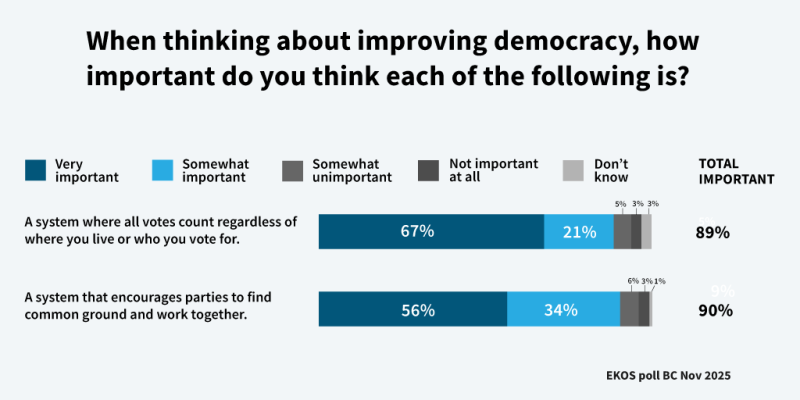
EKOS 2025 BC poll, pie charts shows support for proportional representation by party voters - 78% BC NDP, 73% BC Con, 82% BC GreenFurthermore, voters support an electoral system in which every vote counts and that incentivizes parties to work together:
EKOS 2025 BC poll, bar charts show 90% of voters think every vote should count no matter where you live and 89% think system should incentivize parties to cooperate
Only a more proportional system can deliver on these values.
In the last BC election, voter choice was slashed when BC United dropped out, resulting in a polarizing election and barely more than a two-party system.
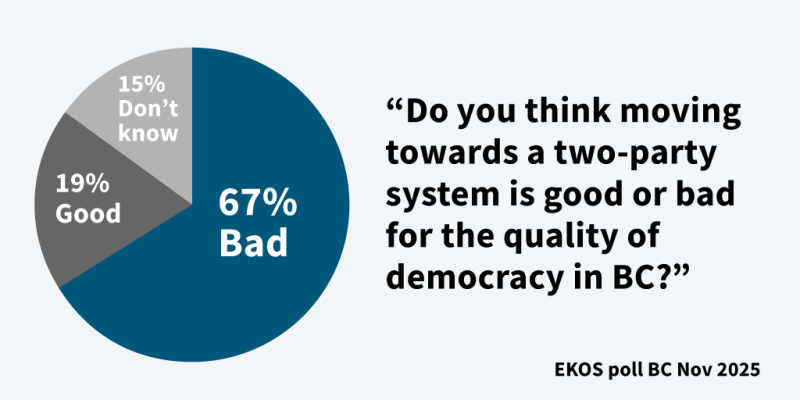
A strong majority of BC voters think a two-party system is bad for democracy in BC:
EKOS 2025 BC poll, pie chart shows 67% think a two-party system is bad for democracy in BC, 19% think it’s good, 15% don’t know
In the United States, with winner-take-all voting and a two-party system, polarization has reached a dangerous level.
Political polarization is a growing concern in Canada. An April 2025 poll showed that in both Canada and the US, strong majorities now believe that the party on the opposite side to them is a “threat to their country”.
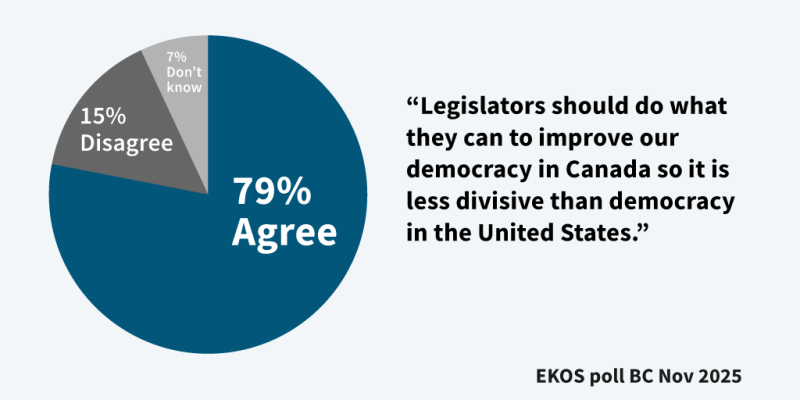
British Columbians believe legislators should act:
EKOS 2025 BC poll, pie chart shows 79% agree legislators should do what they can to ensure our democracy is less divisive than in the US
The research evidence is clear: Countries with proportional representation are less polarized.
With proportional representation, voters have more options on the ballot, so elections do not boil down to a divisive “us vs them” choice. People in countries with proportional representation are used to seeing parties across the political spectrum find common ground and work together.
Around the world, proportional representation is achieved by multi-party agreement – the result of negotiation and compromise.
A non-partisan Citizens’ Assembly on Electoral Reform, tasked with providing feedback to the BC legislature about how to implement proportional representation in BC, would be a significant step in the right direction.
Another example of how you can’t call our current systems democratic
When the public wants something because everyone knows and understand that it is a good idea … then it should be instituted and made possible. That’s democratic
When the idea is constantly blocked, delayed or dismissed … then it means that there are other forces in play that don’t want to represent the people or their wishes. It means that the system is not democratic.